Resources
The Klaviyo Segment Most Brands Forget to Exclude and Why It's Feeding the Promotions Algorithm
Author :
MailMend Team

KEY TAKEAWAYS
One overlooked segment, your unengaged subscribers, does more damage to inbox placement than most content or design choices.
Klaviyo's default suppression settings don't fully solve this. They stop sends, they don't repair the reputation damage already done.
Fixing how to stop emails going to promotions tab starts with segmentation, not subject lines.
A 90-day no-open window is a reasonable starting point, but the right cutoff depends on your sending frequency.
Re-engagement campaigns need their own separate rules. Sending your normal campaign to a cold segment makes the problem worse.
Ask ten people **how to stop emails going to promotions tab** and nine of them will talk about subject lines, emojis, or discount codes. Almost nobody starts with segmentation. That's the gap.
We look at a lot of Klaviyo accounts at MailMend, and the same issue shows up constantly. Brands keep sending full campaigns to subscribers who haven't opened an email in six months, sometimes longer. Gmail notices, and it notices a lot faster than most people expect, which is exactly why how to stop emails going to promotions tab is one of the first questions we get asked.
The segment nobody excludes
Every Klaviyo account has a chunk of subscribers who signed up once, maybe grabbed a discount code, and never opened another email. They're still on the list. They're still getting sent to. And every send to that group tells Gmail something about your domain that you don't want it to hear.
This group is doing more damage than almost anything in your template. Low engagement at scale, repeated over months, is one of the clearest signals feeding a domain's Promotions classification. A single ignored campaign barely registers. Months of the same pattern does.
This is the real answer to how to stop emails going to promotions tab for a lot of brands. Not the copy, not the layout but the list.
Why suppression alone doesn't fix it
Klaviyo has suppression tools built in. Most brands assume flipping one on solves the problem. It helps but it's not the full fix.
Suppression stops future sends to a segment. It doesn't undo the reputation signal already sent to Gmail from months of ignored campaigns. Think of it like a credit report. Closing a bad account stops new damage. It doesn't erase the history already on file.
So brands suppress the segment, wait a week, and wonder why placement hasn't moved. It takes longer than a week. Usually more like a full sending cycle or two before Gmail's engagement model catches up.
What a real exclusion window looks like
There's no single number that works for every account. We generally start conversations around a 90-day no-open window as a baseline, then adjust based on how often a brand actually sends.
IN-ARTICLE IMAGE · supports this section
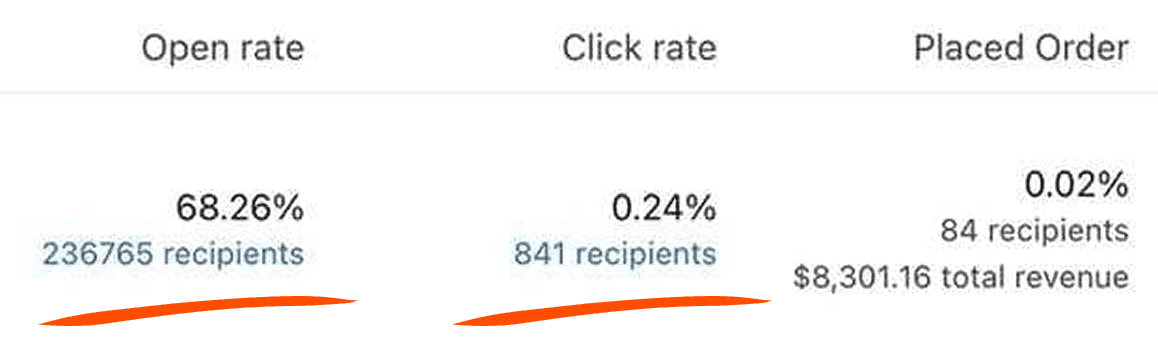
Engagement by segment, the signal that feeds Promotions placement.
A brand sending twice a week needs a tighter window than one sending twice a month, because the same 90 days represents a very different number of ignored emails. Twenty-six unopened campaigns is a stronger signal than eight.
Pull the segment. Check it against purchase history first, because someone who buys without opening emails is a different case entirely and shouldn't be treated as disengaged just because they don't click through.
The re-engagement trap
Here's where a lot of brands make it worse. They pull the cold segment, then send that segment the exact same weekly campaign everyone else gets.
That's backwards. A cold segment needs a different approach entirely, usually a short, low-frequency re-engagement series with a real reason to open, not a recycled promo. If they don't respond to that either, it's time to remove them, not keep trying every week.
We've seen brands run this the other way, treating re-engagement as just another regular send, and watch their overall engagement rate drop further because the cold segment drags down every single campaign average it touches.
Where this connects to promotions tab placement specifically
Segmentation touches engagement history, which is one of three separate signals Gmail evaluates before deciding whether an email lands in Primary or Promotions. It's not the only lever, but for accounts with a large, aging list, it's the biggest one.
A brand asking how to stop emails going to promotions tab while still mailing a five-year-old unengaged list is fighting the wrong battle. Clean the list first. Everything else works better once that's done.
Cleaning the list is where you start, but it's not the layer that ultimately decides Primary versus Promotions. That decision happens at the email header level, and the header is exactly where MailMend works, the signal that copy tools, list and segmentation tools, and reputation and warmup tools never touch. Once your list is clean, the header is the layer left to fix, and it's the one MailMend is built for. We work at the header level across every Klaviyo campaign and flow, with no content rebuild, no new sending strategy, and no change to your copy, design or list. Installation takes about 15 minutes, and because MailMend runs as a native Klaviyo A/B test, you can watch the difference with it on versus off. It doesn't replace your list-hygiene work, it adds the placement layer on top, which for most brands is the missing piece.
See where your Klaviyo emails actually land
If you've cleaned your unengaged segment and you're still stuck in Promotions, placement is the layer left to fix, and it's the one MailMend is built for. We work at the header level, the signal that decides Primary versus Promotions, across every Klaviyo campaign and flow, with no change to your copy, design or list, and it's live in about 15 minutes. Watch the difference in a native Klaviyo A/B test with MailMend on versus off. Book a demo or start your 30-day trial and see where your emails are really landing.
Frequently Asked Questions
How to stop emails going to promotions tab if my list is already clean?
If segmentation is already tight, the issue is more likely sending pattern or content markup. Check those two before assuming list hygiene is the culprit.
How long should a no-open exclusion window be?
There's no universal number. A 90-day window is a reasonable starting point, but brands sending more frequently should consider a tighter window.
Should I delete unengaged subscribers or just suppress them?
Suppress first and run a short re-engagement attempt. If there's still no response, removing them protects your sender reputation more than keeping them on file suppressed indefinitely.
Does this affect deliverability or just promotions tab placement?
Both, though the effect on placement is usually more visible first. Deliverability issues tend to show up later if the pattern continues.
Will Klaviyo's built-in suppression settings handle this automatically?
Partially. Suppression stops future sends but doesn't retroactively repair reputation. Manual review of the exclusion criteria still matters.